
Alert fatigue is the quiet crisis of streaming operations: thousands of signals a day, most of them noise, the critical ones buried. Nala Sentinel 3, NPAW’s third-generation AI agent, watches everything, ranks by business impact and acts, before the viewer ever notices.
Walk into any streaming NOC at scale and you will find the same paradox: more monitoring than ever, and less clarity. CDN, origin, encoding and player layers each emit thousands of alerts a day. Support teams, meanwhile, handle viewer complaints reactively, usually without any real-time link to the technical incident causing them. Escalation runs on tribal knowledge that does not survive the night shift.
Adding headcount does not fix this. Humans cannot watch everything, all the time, and correlate every signal in seconds. That is not a staffing problem; it is a species problem. It is also precisely the kind of problem AI agents are built for.
An agent, not another dashboard
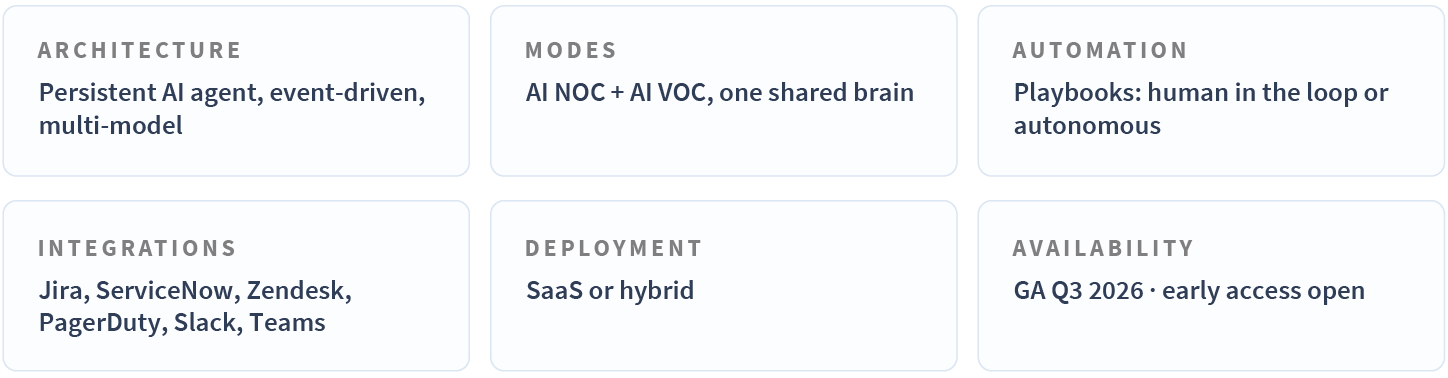
Sentinel 3 operates as a persistent AI agent embedded in the operator’s video stack. It ingests telemetry from the NPAW Suite, CDN logs, origin health checks, encoder metrics and player-side QoE continuously, no polling, no sampling. A multi-model ensemble learns normal baselines per content type, region, device and time of day, and detects deviations 5 to 15 minutes earlier than threshold-based alerting.
Then comes the part human teams struggle with most: triage. Every incident is scored by affected viewers, revenue exposure, SLA risk and content criticality, premium live sport is not treated like back-catalogue VOD. The NOC sees a prioritised queue, not a flat wall of red. Root-cause analysis correlates signals across every layer and presents a diagnosis with evidence, not just an alarm.
For known incident patterns, Sentinel 3 executes remediation playbooks, CDN failover, encoder restart, cache purge, viewer notification, with human-in-the-loop approval or, where the operator allows it, fully autonomously.
We saw our customers’ NOC and VOC teams solving the same incidents from opposite ends, one watching dashboards, the other reading tickets. Sentinel 3 connects both worlds with a single AI brain that acts before the viewer even notices.
One brain, two rooms
What makes Sentinel 3 unusual is that it works both sides of the operations house. In NOC mode it serves network and video engineers: prioritised incidents, auto remediation, cross-layer diagnosis. In VOC mode it serves support and CX teams: every viewer ticket is enriched with the correlated technical incident, the session’s QoE timeline and a draft response. An incident detected in the NOC is instantly linked to the tickets it causes, and vice versa. Two teams that used to solve the same problem from opposite ends finally share one brain.

Scale the service, not the team
The programme’s quantified results frame the business case: 70% faster mean time to detect, 50% faster mean time to resolve, 80% fewer false-positive escalations reaching senior engineering, and 3× faster first response on viewer-facing tickets. The deeper promise is structural: 24/7 coverage that scales with the service rather than the headcount. Sentinel 3 reaches general availability in Q3 2026, with an early-access programme open to NPAW Suite customers, including a 30-day proof-of-value measured on the operator’s own MTTD and MTTR.
At a Glance
Bring us a week of alerts, we’ll show you what Sentinel 3 can triage and resolve
Meet NPAW at IBC 2026, Hall 5, Stand F44
Prefer to read it offline?
Download the full article as a PDF and keep it handy for future reference.
About NPAW
NPAW is the leading business intelligence company for streaming video providers. Using the NPAW Suite of monitoring and delivery solutions, we service over 200 global OTTs, broadcasters and telecom operators. Learn more about the NPAW Suite today.